
Things to see in Cannes
Cannes is closely associated with cinema and grand hotels, but its older streets, harbour and offshore islands tell a broader story. The former fishing village began to expand during the nineteenth century, when British and Russian aristocrats chose it as a resort. Luxury hotels followed in the early twentieth century, shaping the seafront identity for which the city became known.
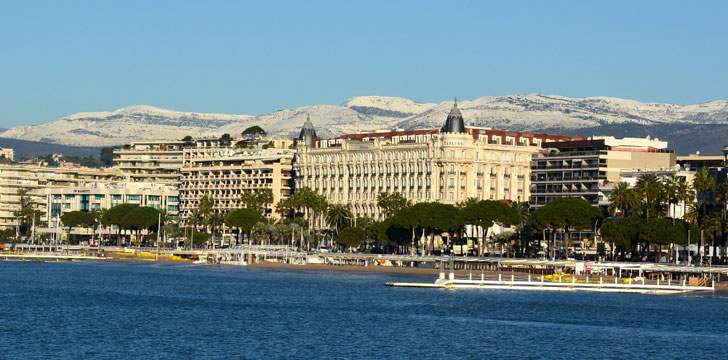
La Croisette and the Palais des Festivals
La Croisette developed from a coastal path into the broad promenade that now defines central Cannes. It passes grand hotels, fashion houses and a pine-shaded pedestrian area before reaching the cape and cross from which the boulevard takes its name. The beaches along this part of the coast form another prominent element of the seafront.
The Palais des Festivals is the principal venue associated with the Cannes Film Festival. The present building, designed by British architect Hubert Bennet and French architect François Druet, was constructed in 1979 to replace the former casino used by the festival. Its eighteen auditoriums and later Espace Riviera extension were designed to accommodate large cultural and professional events.
Le Suquet and the old town
Le Suquet occupies the hill above the harbour and is the oldest quarter of Cannes. Medieval lanes wind around the former citadel, while Rue Saint-Antoine provides the neighbourhood’s main commercial axis. The hilltop group includes a tower, the Chapelle Sainte-Anne and Notre-Dame-de-l’Espérance.
Notre-Dame-de-l’Espérance stands on Place de la Castre. Financed by the town’s inhabitants and completed in 1627 after more than a century of construction, the church combines a Gothic main structure with a square Romanesque bell tower and a Renaissance porch. Its side chapels were historically linked to craft guilds, which were responsible for their decoration.
The Musée de la Castre occupies remains of the medieval castle once held by the monks of Lérins. Its collections range across Mediterranean antiquities, musical instruments from Asia and Africa, objects from Oceanic, Himalayan and Arctic cultures, and paintings connected with Provence. This gives the museum a scope extending well beyond the history of Cannes itself.
The Old Port, Forville and Rue d’Antibes
The Old Port lies by the western jetty, facing the Lérins Islands and within the central area shared by Le Suquet and La Croisette. Its position records the maritime side of Cannes beneath the city’s resort image. Marché Forville stands just behind the port’s western side. Redesigned in 1934, the covered market has traditionally brought together stalls selling fruit, vegetables, fish and other fresh produce.
Rue d’Antibes follows a former national road that connected Cannes with Antibes. It developed into the main shopping street away from the luxury boutiques of La Croisette, with a greater emphasis on general fashion and town-centre retail. The contrast between this street, the market and the waterfront makes the centre easy to read as a sequence of distinct urban areas.
The Lérins Islands
The Lérins archipelago lies in the Bay of Cannes between Golfe-Juan and the Golfe de la Napoule. Its two principal islands have different historic characters. Sainte-Marguerite, the larger and better-known island, contains Fort Royal, traditionally associated with the prisoner known as the Man in the Iron Mask. A thirteenth-century tower within the fort also became the subject of a local haunting legend linked to the prisoner.
Saint-Honorat is distinguished by its monastery. Buildings constructed between the eleventh and fourteenth centuries were for a long period home to a Cluniac community. Seen alongside the old town and port, the islands add monastic and military history to a city more commonly viewed through its twentieth-century film culture.