
Things to see in Nice
Nice brings together a Mediterranean waterfront, an old town of close-set lanes and a substantial architectural legacy. Its history as the capital of the County of Nice, followed by periods under the Kingdom of Sardinia and pre-unification Italian states, is still legible in its churches, squares and civic buildings.
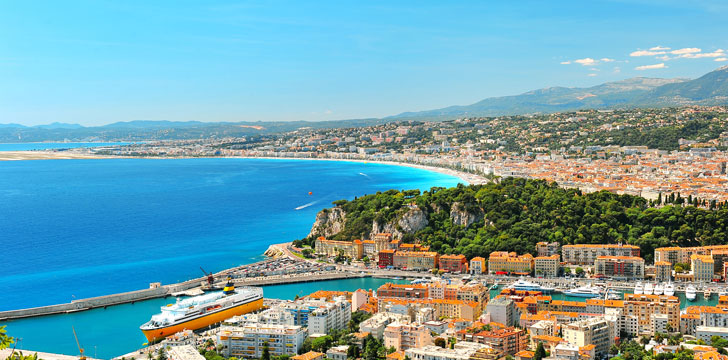
The seafront and Castle Hill
The Promenade des Anglais runs along the shore from east to west and is the city’s best-known public avenue. In the nineteenth century, when the route was still an unmade path, the English clergyman Reverend Lewis Way financed improvements to it. The promenade later acquired its distinctive lamps, kiosks and pergolas, creating a long seafront route used by walkers and runners.
At its eastern end, Castle Hill rises above the old town. A fortress occupied this rocky site from the eleventh to the seventeenth century, but reconstruction was abandoned after successive sieges. Under Charles Felix in the nineteenth century, the hill was laid out with trees, paths and waterfalls. The result is a landscaped historic site rather than a surviving castle.
Vieux-Nice and the central squares
Vieux-Nice lies between Castle Hill, the sea, Place Garibaldi and Place Masséna. Its narrow streets contain food shops, restaurants and artists’ galleries. Cours Saleya is the quarter’s principal pedestrian thoroughfare, known for its flower stalls, cafés and small shops. During the nineteenth century, publisher Benoît Visconti ran a literary salon here for more than half a century; the booksellers along the street continued that literary association.
Place Masséna is one of the city’s principal gathering and performance spaces. Place Garibaldi, towards the port, has a more enclosed rectangular plan, with arcaded buildings sheltering cafés and restaurants. Nearby, the Albert I garden is one of Nice’s older public gardens and includes a stage used for performances.
Opera and religious architecture
The Opéra de Nice stands in the old town. Rebuilt after a fatal nineteenth-century fire, it has an eclectic exterior and a large auditorium; the city’s philharmonic orchestra, choir and ballet are based there. Sainte-Réparate Cathedral, built between 1650 and 1699 under Jean-André Guiberto, has a Latin-cross plan, a coloured Genoese-style dome and a Baroque interior.
The Chapelle de la Miséricorde was designed by Bernardo Antonio Vittone and constructed between 1747 and 1770 on the site of the Sardinian king’s salt stores. Its Piedmontese Baroque design centres on an elliptical nave with matching side chapels and a blue ceiling fresco. On Avenue Jean-Médecin, the neo-Gothic Notre-Dame basilica was built to Louis Lenormand’s plans between 1864 and 1868. The Russian Orthodox Cathedral of Saint Nicholas reflects the sizeable Russian community that settled in Nice during the nineteenth century.
Cimiez and Port Lympia
Cimiez forms a separate cultural group above the historic centre. Its Roman amphitheatre dates from the first century and was enlarged in the third. The nearby monastery, founded by Benedictine monks in the ninth century, contains works by Louis Brea as well as a museum devoted to Franciscan life in Nice. The Musée Matisse occupies the Villa des Arènes and grew from donations by Henri Matisse, who lived in the city from 1917 to 1954, and by his heirs.
Port Lympia takes its name from the river that once supplied a lake on the site. Harbour works began in the seventeenth century, and the port developed into Nice’s main maritime basin. Together with Notre-Dame-du-Port and the neoclassical buildings of Place Île-de-Beauté, it provides a final architectural cluster beyond Place Garibaldi.