Mercantour National Park
Mercantour National Park crosses the Alpes-Maritimes and Alpes-de-Haute-Provence departments, close to the Italian frontier. The Southern Alps meet Mediterranean country here: high summits and mountain lakes give way southwards to steep gorges, drier rock and cultivated slopes. Six distinct valleys make up the park, each with its own terrain and human history.
High country and southern valleys
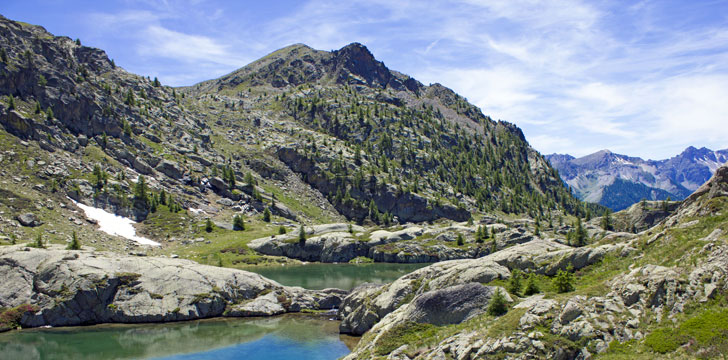
The park’s central zone covers almost 70,000 hectares, while the surrounding area is more than twice that size. Its territory takes in 21 communes. Cime du Gélas is the highest point at 3,143 metres, and five other summits also rise above 3,000 metres. Mont Bégo, Cime de la Bonette and Cime du Mercantour are among the lower, but still substantial, peaks named in the park.
The eastern mountain edge meets Piedmont across the border. Farther south, the Alpine foothills form a transition towards Mediterranean terrain. The Vésubie valley shows that change particularly clearly: pasture, forest and mountain dominate the north, while gentler southern slopes have allowed terraces for vines and olives. Water has cut narrow, steep-sided gorges through the Haut-Var and Cians valleys. Along the Tinée, the mountain scenery is joined by perched hamlets such as Bairols and Roure.
Lakes, rock art and valley heritage
Lac d’Allos lies above 2,000 metres beneath the Mont Pelat massif. It covers about 60 hectares and reaches a depth of 50 metres in places. The Lacs de Vens form another distinctive group: five lakes connected by water flowing from one into the next. These high-water landscapes sit alongside deeply incised river valleys, so neighbouring parts of Mercantour can look markedly different.
The Vallée des Merveilles contains more than 45,000 examples of prehistoric rock art. The oldest date from the Bronze Age, while later markings extend the record beyond that period. Tools, weapons and horned figures appear among the subjects. Human heritage is also visible in the Roya and Bévéra valleys, where Breil and Sospel have Baroque churches and the painted chapel of Notre-Dame-des-Fontaines stands near La Brigue.
Wildlife and plant life
Mercantour’s position between Alpine and Mediterranean climates brings very different species into a relatively compact area. Ibex, wolves and eagles share the park with smaller animals including dragonflies and grasshoppers. Northern species such as rock ptarmigan occur alongside the green lizard of warmer Mediterranean country. Marmots are also part of the park’s fauna.
The same transition is apparent in the plants. Larches, orchids, génépi, lilies, gentians and edelweiss grow in the mountains. Lower down, alpine grassland and heath eventually give way to olive country. A number of plants are endemic to Mercantour, which means that their natural range is confined to this area.
Protection, partnership and weather
Mercantour’s protected history began before the national park itself. Victor Emmanuel II of Italy made the area a royal reserve in the second half of the nineteenth century. It became a hunting reserve in 1946, then a nature reserve in 1951. The national park was created in 1979. Since the late 1980s it has worked with the adjoining Alpi Marittime park in Italy, extending conservation work across the border.
Weather deserves close attention in this meeting place of warm and cold air. Winters are relatively mild for the Alps, but heavy rain can be sudden and may trigger landslides. Warm Mediterranean air often brings summer thunderstorms. Anyone heading into the mountains should use current local forecasts and park guidance, and leave wildlife and the Vallée des Merveilles rock art undisturbed.