
Things to see in Aix-en-Provence
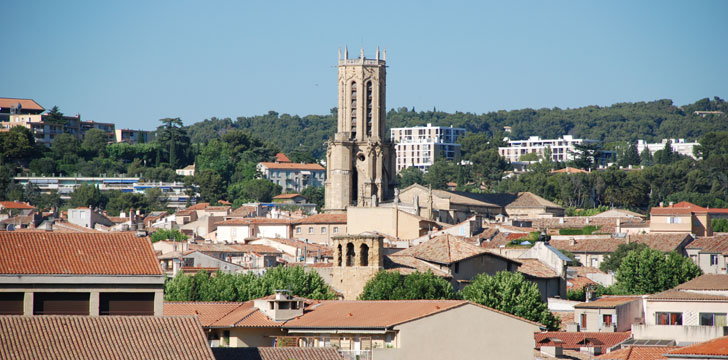
Aix-en-Provence combines Roman origins and a long thermal tradition with streets shaped largely between the Middle Ages and the eighteenth century. Its old centre, Cours Mirabeau and Quartier Mazarin can be explored as one connected historic area, with Montagne Sainte-Victoire rising beyond the city.
Old Aix and Cours Mirabeau
Vieil Aix is the historic core, with buildings ranging from the medieval period to the eighteenth century. Much of the quarter is pedestrian, so its narrow streets provide a practical route between the main squares, churches and museums. At its edge, the Fontaine de la Rotonde marks the end of Cours Mirabeau.
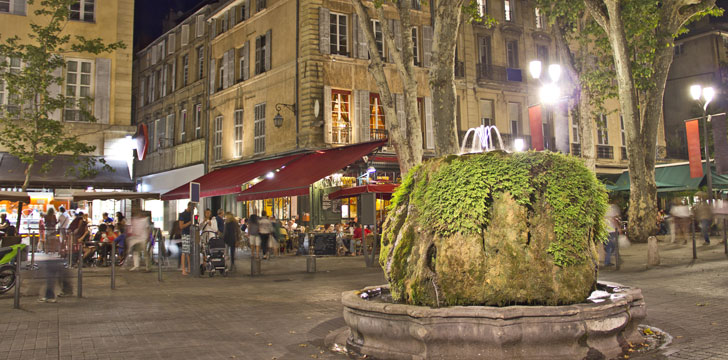
The Cours was laid out in the mid-seventeenth century on the line of the former southern rampart. Its creation formed part of Archbishop Michel Mazarin’s plan to improve the city, and it received the name Mirabeau in 1876. Seventeenth- and eighteenth-century town houses line the avenue, together with several fountains. Among them are the Neuf-Canons fountain and a fountain on the Cours whose stonework is covered with moss.
The Rotonde itself was inaugurated in 1860. Designed by engineer Théophile de Tournade, it rises to 12 metres above a basin more than 30 metres across. Four groups of lions stand around the rim, and three allegorical figures crown the fountain.
The Quartier Mazarin and civic squares
South of Cours Mirabeau, the Quartier Mazarin was developed in the seventeenth century under the same archbishop. Its formal streets contain private mansions and ornamented fountains, but its first residents were not exclusively aristocratic: many owners were craftspeople or traders. The placement of carriage entrances on the wider streets and humbler access from side lanes still reflects that social mixture.
Place des Quatre Dauphins lies within the quarter. Jean-Claude Rambot created its Baroque fountain, where four dolphins support a central form that has carried different ornaments over time. North of the Cours, Place de l’Hôtel de Ville is a rectangular fourteenth-century square. Its town hall, directed by Pierre Pavillon with work by Rambot, draws on Italian Renaissance palace architecture; an astronomical clock is another defining feature of the square.
Art and religious heritage
Musée Granet opened in 1838 in the former church of Saint-Jean-de-Malte. François Marius Granet, whose bequest included a large collection of drawings, became its principal benefactor and gave the museum its name. The collections also connect Aix with Paul Cézanne, an artist closely associated with the city who repeatedly painted its surrounding landscape.
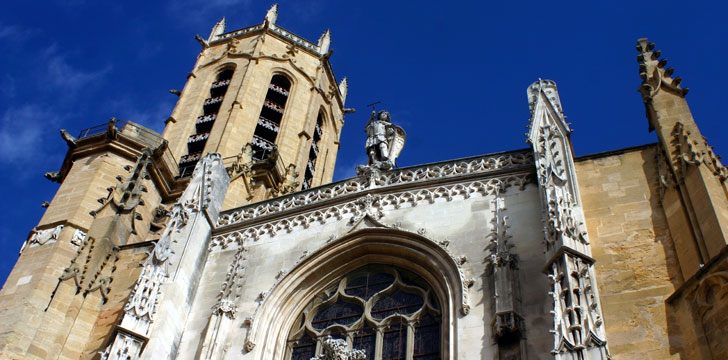
Cathédrale Saint-Sauveur occupies the site of the ancient forum. Its fabric combines Romanesque and Gothic work: construction extends from the twelfth-century nave façade to the fifteenth-century portal. Among the works associated with the cathedral are the sarcophagus of Saint Mitre and Nicolas Froment’s fifteenth-century triptych The Burning Bush, commissioned by King René.
Montagne Sainte-Victoire
Montagne Sainte-Victoire is the natural reference point of the Aix countryside. Cézanne made it the subject of around sixty paintings. Its two faces support contrasting plant life: Mediterranean vegetation grows on the sunnier southern side, while the less exposed northern slope has alpine flora. The mountain therefore adds both artistic context and a distinct landscape to a visit centred on Aix.