
Things to see in Marseille
Marseille, the departmental capital of Bouches-du-Rhône, is a Mediterranean port city shaped by trade, migration and a long religious and military history. Its familiar associations with pétanque, bouillabaisse and Marseille soap sit alongside monumental churches, forts, museums and coastal districts.
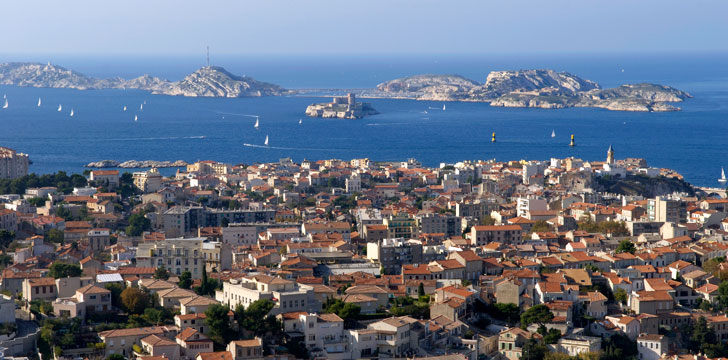
The Vieux-Port and central Marseille
The Vieux-Port is the historic and civic centre of Marseille. Its history reaches back to the sixth century, while quays for ships were added in the fifteenth. During the nineteenth century it handled goods moving through the Mediterranean and to French colonies; commercial traffic was later transferred to the larger port. The old basin subsequently developed as a marina and transport interchange, with cafés and restaurants lining its quays.
From the Quai des Belges, La Canebière runs inland towards Boulevard de la Libération. The avenue as it is known today combined three earlier streets: the old Canebière, Rue Noailles and the Allées de Meilhan. The Palais de la Bourse and the church known as Les Réformés are among the buildings associated with this central axis.
Le Panier and the northern waterfront
Le Panier rises north of the Vieux-Port in Marseille’s second arrondissement. It is the city’s oldest quarter and has passed through periods of poverty and extensive renovation. Its close streets provided inspiration for the settings of the film Borsalino and the television series Plus belle la vie.
Nearby, the Cathédrale Sainte-Marie-Majeure, usually called La Major, was designed by Léon Vaudoyer and built in a neo-Byzantine style during the second half of the nineteenth century. Marble decoration, a length of more than 140 metres and a height exceeding 60 metres give the cathedral its monumental scale.
Fort Saint-Jean preserves several periods of Marseille’s military history. First built in the twelfth century and strengthened in the thirteenth and fourteenth, it defended the city before becoming a prison during the French Revolution. The fort was badly damaged by the explosion of an ammunition store in 1944. The MuCEM, opened in 2013 as the Museum of European and Mediterranean Civilisations, occupies part of the site and is connected to the fort by a 130-metre footbridge. Its founding collections came from the Musée national des Arts et Traditions populaires and the Musée de l’Homme in Paris.
Landmarks above the port
Notre-Dame-de-la-Garde stands on high ground overlooking the city and harbour. The Roman Catholic basilica was built between 1853 and 1864, with Espérandieu as its principal architect. A figure of the Virgin more than ten metres high crowns its marble bell tower, reinforcing the church’s historic association with sailors and fishermen.
Palais Longchamp, another work by Espérandieu, was inaugurated in 1869. Its central water tower commemorates the arrival of water from the Durance, while the two wings house the fine-arts and natural-history museums. Gardens extend behind the architectural group. On the opposite side of the old harbour, Saint-Victor Abbey has origins in the fifth century. Its Romanesque nave, Gothic side aisles, transept and choir record later phases of construction, and its crypts contain a notable group of sarcophagi.
The coast, the Calanques and Château d’If
The Corniche follows the shoreline for almost four kilometres between Plage des Catalans and the Prado beaches. Along the route, Vallon des Auffes forms a small fishing harbour about two and a half kilometres from the Vieux-Port. Its name comes from alfa grass, once used to make ropes and ships’ hawsers. Farther south, Les Goudes marks the transition from the urban coast to the Calanques.
The Calanques extend for more than twenty kilometres between Les Goudes and Cassis, where the sea cuts narrow inlets into the land. Offshore, the Frioul archipelago contains Château d’If. François I ordered the fortress, which was built between 1527 and 1529 to defend Marseille. It later became a prison, holding Protestants and, in the nineteenth century, republicans. Alexandre Dumas gave the castle a lasting literary role as the prison of Edmond Dantès in The Count of Monte Cristo.