
Things to see in Arles
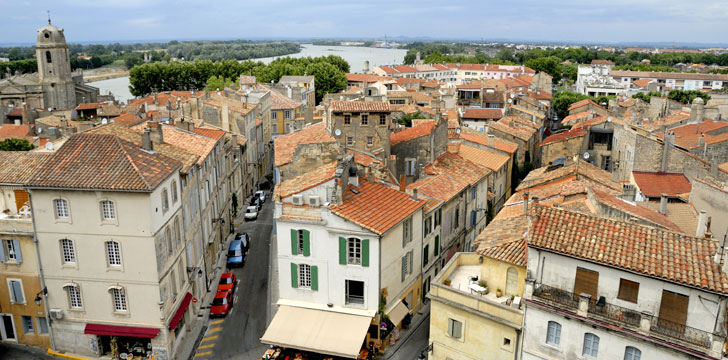
Arles, in Bouches-du-Rhône, has an unusually visible span of history. Roman monuments sit close to medieval Saint-Trophime and the seventeenth-century town hall, while the wider area reaches towards Montmajour and the wetlands of the Camargue.
Roman Arles
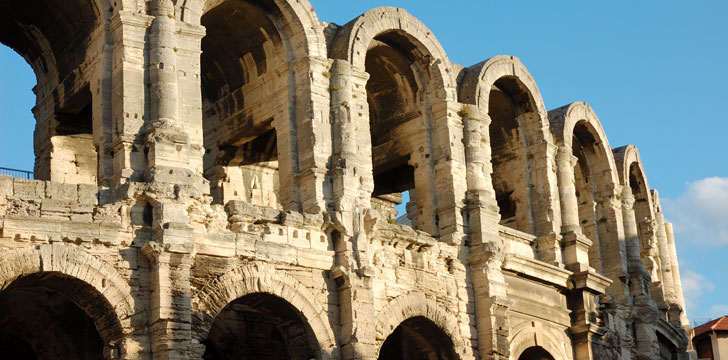
The Arènes are the clearest starting point for the city’s Roman past. This amphitheatre was built at the end of the first century AD, during the reign of Domitian, with Rome’s Colosseum as a model. It is less complete than the amphitheatre at Nîmes, but predates it and is larger. A restoration was completed in 2006.
The Théâtre Antique belongs to an earlier phase. Built under Augustus at the end of the first century BC, it had a semicircular auditorium and a stage building along its base. Busts recovered during archaeological work indicate the richness of its decoration. The Thermes de Constantin add a fourth-century layer to the Roman story. Long mistaken for palace ruins, the surviving baths include three pools, one of them set within an apse.
The Musée de l’Arles Antique puts these remains into context. Its collections move from prehistory and protohistory through the early Roman Empire to late antiquity, with a notable group of sarcophagi. This chronological arrangement helps explain how the settlement founded under Julius Caesar developed across the centuries.
Squares, church and town hall
Place de la République occupies the civic and religious heart of Arles, just south of the ancient forum. In the Middle Ages it was a confined forecourt between the churches of Saint-Trophime and Sainte-Anne. Expansion began around the construction of the town hall, and the square gradually acquired its present mixture of buildings. The obelisk at its centre once stood in the Roman circus.
Saint-Trophime was built between the twelfth and fifteenth centuries. The church is principally Romanesque, while its choir dates from the Gothic rebuilding of the mid-fifteenth century. Inside are Aubusson tapestries depicting episodes from the lives of the Virgin and Christ. Beside it, the Hôtel de Ville dates from the second half of the seventeenth century. Jacques Peyret drew up the plans, and the façade is credited to Jules Hardouin-Mansart, later associated with the Grand Trianon and Les Invalides.
Place du Forum marks another ancient centre. The Roman forum stood where the north–south and east–west routes met and once covered more than 3,000 square metres. The surviving square is much smaller. It is also linked with Vincent van Gogh, who painted the café terrace here at night in blue and yellow tones.
Montmajour and the Camargue
Outside the centre, Montmajour Abbey records almost eight centuries of religious building. The Benedictine monastery was founded in the mid-tenth century and grew through additions made between the eleventh and eighteenth centuries. Abandoned during the French Revolution, it was protected as a historic monument in 1840. Van Gogh painted the site at dusk in Sunset at Montmajour in 1888.
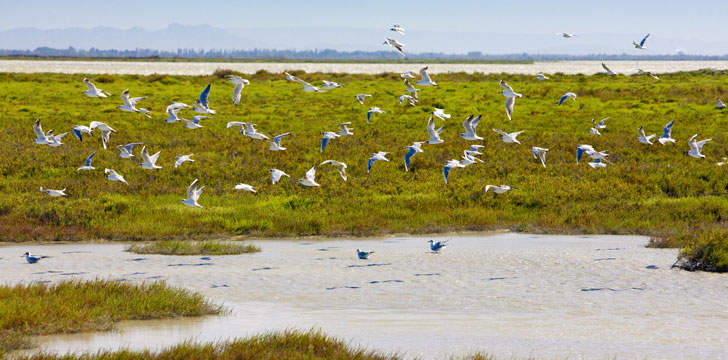
The Camargue Regional Nature Park lies between branches of the Rhône delta. Marshes form much of its landscape, supporting abundant birdlife and the flamingos closely associated with the area. It provides a marked change of scale from the compact streets and masonry of central Arles.