
Camargue Regional Nature Park
South of Arles, the Rhône divides around a low-lying delta of marshes, lagoons, dunes and salt water. Camargue Regional Nature Park lies in the Bouches-du-Rhône department, between the river’s two branches and the Mediterranean coast running from Saintes-Maries-de-la-Mer towards Port-Saint-Louis-du-Rhône.
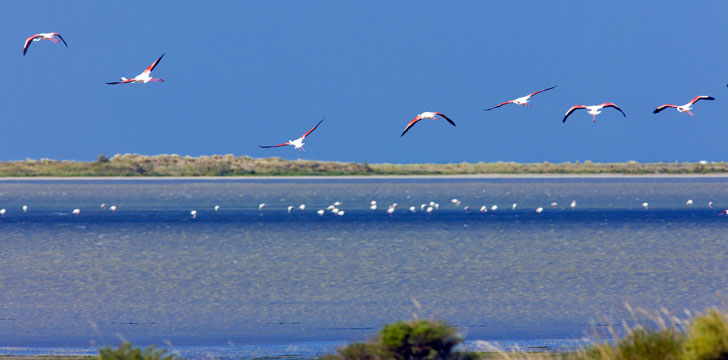
The park was established in 1970 to protect a delta that is often described as wild but has also been moulded by generations of human activity. Water, land use and seasonal change all leave their mark here. Camargue horses and bulls are part of that working landscape, alongside the birds and wetland plants for which the area is known.
A delta of fresh and salt water
The meeting of river and sea creates sharply different habitats within a relatively flat area. Freshwater marshes sit near brackish lagoons, sandy ground and coastal dunes. The Domaine de la Palissade, near Salin-de-Giraud, brings several of these environments together: visitors can see dunes, lagoons and both fresh and salt water within the same estate.
This is not an untouched wilderness. The park’s character comes partly from the long relationship between natural processes and local livelihoods. Its protected status recognises the need to retain that balance while restoring habitat for vulnerable species.
Birds and wetland plants
Greater flamingos are the Camargue’s most familiar birds, especially when a flock lifts above the lagoons. The marshes also shelter several kinds of duck during winter, as well as cattle egrets. Freshwater pond turtles and coypu live around the waterways. Mosquitoes are another part of the wetland ecosystem and can be particularly noticeable at certain times of year.
The plants change with the ground and its salinity. Glasswort grows where salt is present, while sea lavender, giant reed and sand lilies occupy other parts of the delta. Together, these species reveal small shifts in water, soil and exposure that can be easy to miss in the broad, open scenery.
Wetland sites and local history
The Marais du Vigueirat has signposted walking routes, observation towers and interpretation panels. Its paths cross marshland used by Camargue horses and bull herds, making it a useful place to understand how wildlife and pastoral activity share the delta.
At Étang du Fangassier, flamingos gather to nest during spring and early summer. This is a sensitive phase in their annual cycle, so observation needs to follow the guidance in force at the time. Farther south, Pointe de Beauduc forms a long sandy tongue at the edge of the Camargue, with a scattering of traditional-looking cabins.
The area’s human history can also be approached through the Musée de la Camargue and the Musée du Riz. One examines life in the delta and the way local communities have adapted to it; the other traces rice growing through tools and machinery. Opening arrangements should be checked before travelling.
Exploring without disturbing the marshes
Walking is the simplest way to notice the Camargue’s changes in water, vegetation and birdlife. Some sites can also be explored on horseback, subject to local availability. Parking areas allow visitors to leave the car behind rather than drive through sensitive ground.
Conditions and access can vary across this watery landscape. Stay on the routes provided, keep well back from nesting birds and follow instructions at managed sites. Current opening information is especially important for estates, museums and guided access around breeding areas.